
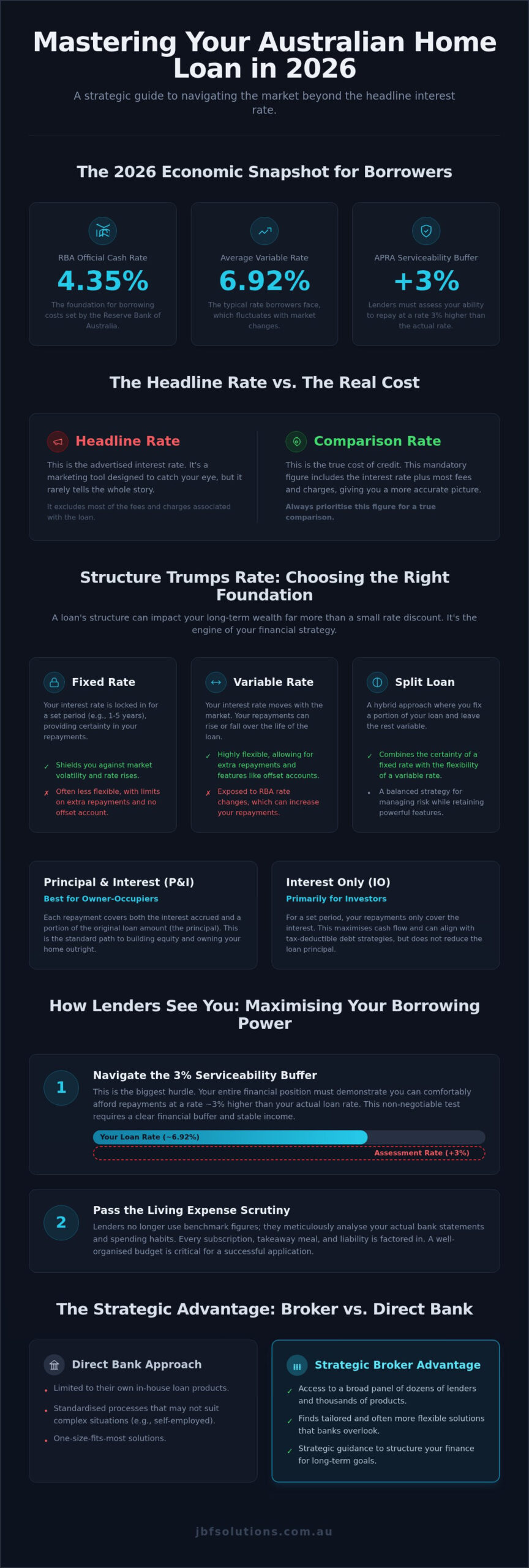
The lowest interest rate on the market might actually be the most expensive mistake you make when securing home loans. It’s a frustrating reality for many Australians who find themselves lured by “headline” rates, only to be caught out by hidden fees or rigid structures that don’t account for their long-term goals. If you’ve felt overwhelmed by the gap between advertised rates and comparison rates, you aren’t alone. Most borrowers feel a sense of unease about over-committing in an economy where the RBA’s cash rate sits at 4.35% and the average variable rate hovers around 6.92%. We understand that for the self-employed, the standard application process often feels like it’s designed to exclude you rather than support you.
JBF Solutions has designed this guide to help you move past the noise and master the technical mechanics of the Australian mortgage market in 2026. We’ll look at why “structural integrity” matters more than a temporary discount and how you can optimise your borrowing power despite the current 3% serviceability buffer. You’ll gain a clear roadmap to property ownership that minimises unnecessary costs and aligns with your broader financial trajectory. From navigating diverse state-based concessions and stamp duty exemptions to leveraging the expanded First Home Guarantee, this is your strategic blueprint for a secure financial future.
Key Takeaways
- Understand how the Reserve Bank of Australia’s cash rate decisions impact your repayments and why a proactive approach to rate fluctuations is essential for long-term stability.
- Discover why the specific structure of your home loans-balancing variable, fixed, and split options-often matters more than securing the lowest advertised interest rate.
- Optimise your borrowing power by understanding how lenders scrutinise your living expenses and navigate the current 3% APRA serviceability buffer.
- Gain a clear roadmap for the loan approval process, from securing a strategic pre-approval to gathering the specific documentation required for a seamless application.
- Understand the advantage of using a strategic broker to access a broader lender panel and find tailored solutions that direct institutional banks often overlook.
Navigating the Australian Home Loan Market in 2026
Entering the property market in 2026 isn’t just about finding a place to live. It’s a high-stakes financial manoeuvre. While many still view home loans as a heavy burden of debt, a strategic approach reframes the mortgage as a sophisticated wealth-building tool. This shift is vital because the Great Australian Dream of home ownership now exists within a complex economic framework that demands more than just a steady income. It requires an alignment of your current cash flow with your future equity goals. We don’t just look at what you can borrow today; we look at how that debt serves your position five or ten years down the line.
The Reserve Bank of Australia (RBA) remains the primary architect of your monthly budget. With the official cash rate currently at 4.35%, the cost of borrowing has stabilised, but it remains significantly higher than the “emergency” lows of previous years. When the RBA moves the needle, your lender usually follows. However, we look beyond the immediate repayment hike to see how these shifts influence long-term borrowing power and property valuations across different states. Successful borrowing in 2026 requires a level of sophistication that goes past simply signing on the dotted line.
Understanding the Comparison Rate
Headline rates are designed to catch your eye. They’re marketing tools. In reality, the “advertised rate” rarely tells the whole story because it ignores the weight of annual fees, legal costs, and valuation charges that can quietly erode your savings. The comparison rate is the mandatory transparency tool for Australian lenders, designed to help you see the true cost of credit over the life of the loan. When we analyse home loans, we prioritise this figure to ensure you aren’t paying a premium for a “discounted” rate that carries heavy hidden costs.
The 2026 Economic Landscape for Borrowers
Lenders are currently operating under strict oversight. The Australian Prudential Regulation Authority (APRA) maintains a 3% serviceability buffer, meaning you must prove you can handle repayments at a rate much higher than the current 6.92% average. This makes “structural integrity” the cornerstone of a successful application. It’s not just about what you earn; it’s about how you’ve organised your liabilities and expenses. Whether you’re buying a home to live in or investing in a property for capital growth, the finance structure must reflect that specific intent. An investment loan requires a focus on tax effectiveness and interest-only options, while an owner-occupied loan prioritises debt reduction and offset flexibility.
Choosing the Right Mortgage Structure for Your Future
Most borrowers obsess over finding the “cheapest” rate. They spend hours scrolling through comparison sites to save 0.10% on a headline figure. While price matters, the structure of your home loans often dictates your long-term wealth more than the interest rate itself. A poorly structured loan can lock you into rigid repayment schedules or strip away tax benefits, costing you far more than a minor rate discount ever could. We look at your mortgage as a flexible financial engine that should be tuned to your specific career trajectory and lifestyle goals.
In the current 2026 climate, where the average variable rate is approximately 6.92%, the choice between fixed and variable is a question of risk management. Fixed rates, currently starting from around 5.99% for one year, offer a shield against market volatility. However, they often lack the flexibility of offset accounts. Many of our clients find the “best of both worlds” by using a split loan strategy. By fixing a portion of the debt for certainty and leaving the remainder variable, you maintain the ability to make extra repayments and use an offset account to reduce interest costs. For those seeking a broader overview of basic products, the Australian government’s guide to home loans is a helpful starting point; however, a bespoke structure requires a deeper analysis of your cashflow.
The decision between Principal and Interest (P&I) and Interest Only (IO) is equally strategic. For a primary place of residence, P&I is almost always the right path to build equity. For investors, an IO period can preserve cashflow and align with tax-deductible debt strategies. If you’re unsure how these features interact with your specific goals, structuring your finance with a specialist ensures you aren’t paying for features that don’t serve your bottom line.
Offset Accounts vs. Redraw Facilities
An offset account is a separate transaction account linked to your mortgage. Every dollar in that account reduces the balance on which interest is calculated. It’s a powerful tool for maintaining liquidity while saving on interest. A redraw facility, by contrast, allows you to pull back extra repayments you’ve made directly into the loan. While redraw is often “free” or cheaper, it can create tax complications if you ever decide to turn your home into an investment property in the future. We generally prefer the transparency and tax-segregation that an offset account provides.
Lenders Mortgage Insurance (LMI) Explained
Lenders Mortgage Insurance is a one-off premium that protects the bank, not you. It typically applies when your deposit is less than 20% of the property value, known as the “80% Rule.” In 2026, with the average first home buyer loan size reaching A$614,048, LMI can be a significant “sunk cost.” We often explore guarantor options or specific professional exemptions to help clients bypass this expense, allowing that capital to stay in your pocket rather than the insurer’s.
Calculating the Real Cost and Your Borrowing Power
Many people jump onto a basic online calculator, punch in their salary, and assume the result is their definitive budget. In the 2026 lending environment, your borrowing power is far more fluid. Lenders don’t just look at your gross income; they dissect your “surplus” cashflow with an analytical lens. This is where the Household Expenditure Measure (HEM) comes into play. It’s a benchmark lenders use to estimate your living costs, but they’ll also scrutinise your actual bank statements. If your digital footprint shows a heavy reliance on Uber Eats, multiple streaming subscriptions, or high-end gym memberships, it signals a lifestyle that might struggle with the 3% APRA serviceability buffer. We’ve seen applications stall not because of low income, but because of high “lifestyle friction.”
How a lender treats your specific income stream is another critical variable. If you’re a nurse working heavy overtime or a sales professional relying on quarterly bonuses, some banks will only recognise 80% of that extra pay. Others might be more flexible. For the self-employed, we look between the lines of your tax returns to find the true profit, often ignored by standard institutional algorithms. It’s also vital to distinguish between your maximum borrowing capacity and your optimal capacity. Just because a bank will lend you A$900,000 doesn’t mean you should take it. I help you find the “sweet spot” where your property goals don’t compromise your quality of life or long-term financial security.
Upfront Costs You Must Budget For
Your deposit is only part of the equation. Stamp duty is the “silent budget killer,” and its impact depends entirely on your state. While the Australian Government first home buyer schemes have introduced significant concessions, you still need to account for conveyancing and legal fees. These ensure your “property ladder” has a solid base by verifying titles and managing the settlement process. We also consider building and pest inspections non-negotiable. Spending a few hundred dollars now protects you from tens of thousands in structural repairs later.
Managing Your Credit Score
Australia’s shift to comprehensive credit reporting means lenders see more than just your defaults; they see your repayment history on everything from phone bills to credit cards. “Buy Now, Pay Later” (BNPL) services are a particular trap. Even if you don’t owe money, the total limit of these accounts is often viewed as an active liability, dragging down your borrowing capacity. Before approaching a lender, it’s wise to “clean up” your file by closing unused accounts and ensuring every bill is paid on time for at least six months. This level of preparation turns a “maybe” into a confident “yes” from the bank.
The Step-by-Step Path to Loan Approval
Once you’ve established your financial baseline, the path to securing home loans becomes a sequence of tactical moves. It begins with pre-approval. This isn’t a mere suggestion; it’s your tactical advantage in a fast-moving auction room. Without it, you’re essentially window shopping with no means to buy. Pre-approval gives you a clear ceiling and shows real estate agents you’re a serious contender. It’s a conditional nod from a lender that says they’re willing to back you, provided the property you choose meets their criteria.
The next phase is documentation, or what we call the “proof of life” for your finances. For many, this means three months of payslips and bank statements. However, for the complex profiles we often handle, it involves tax portals, trust deeds, and profit and loss statements. We ensure every document tells a consistent story of financial reliability. After you’ve found the property, the lender conducts a valuation. They need to ensure the asset supports the debt. If the valuation comes in “short,” we may need to pivot to a different lender or structure. Finally, you reach formal approval and settlement. This is the legal exchange of funds for the title, usually managed by your solicitor and the bank’s legal team.
Special Guidance for the Self-Employed
Business owners often face a “computer says no” response from large institutional banks. We apply “entrepreneurial empathy” to this challenge. We look beyond the surface-level taxable income to understand your actual cashflow and business trajectory. Whether you require a low-doc loan using BAS statements or a full-doc application that accounts for one-off business expenses, we align your business success with your property goals. Having a broker who understands how to read between the lines of a balance sheet is the difference between a decline and a tailored approval. If you’re ready to start the process with a specialist who understands business mechanics, you can assess your borrowing power and begin your application today.
Common Pitfalls to Avoid
The most common mistake is changing your financial profile mid-application. Buying a new car on finance or applying for a high-limit credit card can trigger a reassessment of your borrowing capacity. We’ve seen “perfect” applications rejected because a borrower underestimated the impact of a monthly car repayment. You must also be honest about all debts. Failing to disclose a small personal loan or a “buy now, pay later” account can lead to a decline at the final hour. Remember that owning a home includes hidden costs like council rates, insurance, and ongoing maintenance. We help you factor these in so you aren’t just buying a house, but securing your future.
Why a Strategic Broker Beats a Direct Bank Approach
Walking into a local bank branch feels familiar, but it limits your perspective to a single shelf of products. A bank lender is an employee of one institution; they cannot tell you if the lender across the street offers a structure better suited to your long-term goals. In the competitive landscape of 2026 home loans, choice isn’t just a luxury. It’s a necessity for financial optimisation. We operate as a consultative partner, providing access to a national panel of lenders. This competition ensures that your loan works for you, rather than you working for your loan.
My role as a “Strategic Specialist” involves reading between the lines of complex lender policies. While an institutional bank might see a self-employed applicant as a “high risk” based on a single year’s tax return, I look at the broader mechanics of your business. With over 20 years of industry experience, I understand which lenders value entrepreneurial cashflow and which ones will penalise it. Our relationship doesn’t end at settlement, either. We continue to monitor your rate and the market, ensuring that as your equity grows or the RBA moves, your loan remains aligned with the most competitive options available.
Bespoke Solutions vs. Off-the-Shelf Products
Institutional banks prefer “cookie-cutter” clients because they fit neatly into automated approval algorithms. If you’re a “round peg” in a square-hole system, you need a tailored approach. We specialise in finding home loans for those with complex income streams, including business owners and property investors. By aligning your personal finance with your broader business or investment goals, we ensure your total financial health is considered. This isn’t about a one-off transaction; it’s about a long-term strategy that protects your wealth and minimises unnecessary interest costs.
Taking the Next Step
Preparing for your first consultation is straightforward. I recommend having a clear understanding of your current liabilities and a rough idea of your property goals. We provide a no-pressure environment where the focus is on honest guidance rather than a fast-paced sales pitch. This is likely the biggest financial decision of your life, and it deserves a measured, methodical approach. We’ll guide you from the initial inquiry to informed confidence, ensuring every technical detail is handled with precision. Organise a strategic finance consultation with JBF Solutions today and let’s build a roadmap to your property ownership goals.
Taking Control of Your Property Future
The landscape of Australian home loans in 2026 is undoubtedly complex, but it’s also full of opportunity for those who look beyond the headline rates. We’ve explored how a strategic mortgage structure provides a more resilient foundation than a simple interest rate discount, especially when navigating the current 3% serviceability buffer. Whether you’re a first home buyer leveraging state concessions or a business owner requiring entrepreneurial empathy, the key to success lies in meticulous preparation and professional alignment.
I’ve spent over 20 years helping Australians read between the lines of lender policies to find tailored outcomes. As an FBAA and MFAA accredited specialist, I provide access to an extensive national lender panel, ensuring your finance is optimised for your specific life stage. You don’t have to navigate these technical mechanics alone. By choosing a consultative partnership over a cold institutional bank, you gain a steady hand to guide you through every valuation and settlement hurdle.
Start your strategic loan journey with JBF Solutions
Property ownership remains a powerful wealth-building tool when managed with precision. I look forward to helping you secure a future that is as practical as it is ambitious.
Frequently Asked Questions
What is the difference between a mortgage broker and a bank lender?
A mortgage broker provides access to an extensive national panel of lenders, while a bank lender can only offer products from their own institution. Think of a broker as a consultative partner who compares hundreds of options to find the right fit for your specific financial structure. This choice ensures you aren’t limited to a “one-size-fits-all” product that might not account for your long-term wealth goals.
How much deposit do I really need for a home loan in Australia?
You typically need a 20% deposit to avoid Lenders Mortgage Insurance (LMI), but many Australians purchase with as little as 5% through specific government initiatives. For instance, the First Home Guarantee allows eligible buyers to enter the market with a 5% deposit without the added cost of LMI. We help you calculate whether the cost of LMI is a worthwhile trade-off for entering the property market sooner.
Can I get a home loan if I am self-employed or have a small business?
Yes, you can certainly secure home loans as a business owner by providing alternative documentation like BAS statements or accountant-certified income declarations. While large institutional banks often prefer standard payslips, we apply entrepreneurial empathy to present your business cashflow in a way that lenders understand. It’s about finding a lender whose credit policy aligns with the reality of your business mechanics.
What is an offset account and how does it save me money on interest?
An offset account is a standard transaction account linked to your mortgage where the balance is deducted from your loan principal before interest is calculated. If you have a A$600,000 loan and A$50,000 in your offset, you only pay interest on A$550,000. This structure allows you to reduce the total interest paid over the life of the loan while maintaining full access to your cash for business or personal use.
How long does the home loan approval process typically take in 2026?
In 2026, a standard home loan approval typically takes between five to ten business days from the time of application. This timeline can be faster if your “proof of life” documentation is organised and investor-ready before you approach a lender. More complex applications, such as those involving self-employed structures or trust accounts, may require additional time for a manual assessment by the lender’s credit team.
What happens if interest rates rise after I have taken out my loan?
If you have a variable rate loan and interest rates rise, your lender will generally increase your monthly repayments to cover the higher interest cost. This is why the 3% serviceability buffer is so important; it ensures you can still manage your home loans even if the RBA moves the cash rate higher. We regularly review your rate against the market to ensure your lender stays competitive as conditions shift.
Are there any grants available for first home buyers this year?
Several grants and concessions are available in 2026, including the A$10,000 FHOG in NSW for new homes and a A$15,000 grant in Queensland. In the ACT, stamp duty has been completely abolished for all first-home buyers from July 2026, regardless of the property value. These schemes can often be combined with federal deposit guarantees to significantly reduce the upfront capital you need to secure a property.
Is it better to have a fixed or variable interest rate right now?
The choice depends on whether you value repayment certainty or loan flexibility, as fixed rates currently start around 5.99% while average variable rates sit at 6.92%. A fixed rate protects you from market volatility for a set period, but it often restricts your ability to use an offset account or make large extra repayments. Many of our clients opt for a split loan to get the benefits of both structures.
JB Fremy is the founder of JBF Solutions with 20+ years of experience in finance, technology and business operations. All articles are written by JB and reflect practical, experience-based insights.